ABOUT

Sustainable Land Management

Overview

Te Uranga B2 Incorporation

  • Soils - Yellow brown earth, yellow brown loam, yellow brown pumice
  • Rock Types -Jointed and banded mudstone, pumice, greywacke, limestone, ignimbrite
  • Prevailing Wind - North westerly
  • Rain Bearing Wind - Easterly
  • Altitude: Summit of Mt Hikurangi - 514 above sea level (a.s.l)
  • Altitude: Steeper hill country - 350 - 460 a.s.l
  • Altitude: Top flats - 365 a.s.l
  • Altitude: Flats on Koromiko - 258 a.s.l c
  • Total area - 2,369 ha

Sustainability

Nga Manuka

Approximately 7 hectares of pine trees growing beside the Piaua and Ongarue Ngakonui Roads were harvested in 2014 and a small portion of the revenue has been used to replant the land where the pines were, Classes 7 & 8 of dairy farm land, waterways and gullies with manuka seedlings. Some of these are near maturity and the nectar will be gathered by bees from 6 hive sites scattered strategically around the farm.

Tweeddale Apiarists currently pay the Incorporation $1,000 per site and as the manuka matures the payment will be based on the UMF (unique manuka factor) and the amount of honey in each hive. It is estimated that income from the hives will increase 6-fold.

Shareholders attending annual general meetings have for some years been given litre jars of honey supplied by Tweeddales to take home.

Sustainability

Nga Whenua

Nga Whenua Rahui was established by the government in 1991 to provide funding for the protection of indigenous ecosystems on Maori land. Its scope covers the full range of natural diversity originally present in the landscape.

Cultural use of these natural areas - access to harvest for carving and medicinal use - is blended with the acceptance of public access within the agreements. The objective is long-term protection with inter-generational reviews of conditions.

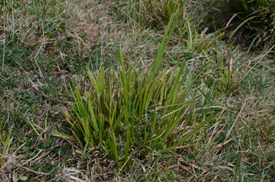
Te Uranga B2's introduction to, what is today termed "sustainable land management", was in effect its 1994 endorsement of a Nga Whenua Rahui Kawenata over 105 hectares of regenerating native forest. Since then a further 4 ecosystems have been withdrawn from farming including 35 ha of wetland known as Te Wharepapa. 16 ha of Te Wharepapa is planted in harakeke (flax) in grid pattern for ease of general maintenance and future harvesting

Horizons

The environmental works programme adopted by the Incorporation was to be enhanced by an approach from Horizons Regional Council to participate in its Whole Farm Plan. This partnership has provided for an assessment of land and water resources, identification of environmental issues and recommendation of tailored best practices, planning integrated business/environmental plans and procedures to monitor responsibilities, maintenance and support.

Marae 2002

This story screened on 'Marae', TVNZ on Sunday 5 July 2002. Derek Fox was the programme's presenter with Derek Wooster producing 'Marae' as well as directing this clip about environmental work on Hikurangi Station (Te Uranga B2 Inc. Taumarunui). Potaka Maipi was the reporter.

Ballance Farm Environment Awards 2013 - Horizons Region

'The Ballance Farm Environment Awards celebrates role models who show how sustainable farming practices can be part of a profitable farm business and can inspire, motivate and educate others.'

Te Uranga B2 was invited to enter the Horizons region of these prestigious awards. At the awards evening in Palmerston North on 8 March Te Uranga B2 won two Specialist Regional Awards:- The Margaret Matthews Trophy for Commitment to Sustainabilty presented to Vonda Houpapa and Horizons Regional Council Award (for the integration of trees) presented to Jack Valois, Upoko Sheep & Beef farm manager. In the Open Section of the awards Dean and Lucy Marshall, sharemilkers on Paatara Dairy farm were presented the LIC Dairy Farm Award.


1:  LIC Representative Bryan Guy (L) with Dean Marshall - 'Paatara Dairy Unit'.

2: Vonda Houpapa with Tim Matthews.

3:  Jack Valois flanked by Horizons Regional Council members Vern Chettleburg (L) Bruce Gordon (R)

Reducing Greenhouse Gas Emissions (GHG) on Māori-owned Farms

Scion, in partnership with AgFirst, are undertaking a research programme funded by the New Zealand Agricultural Greenhouse Gas Research Centre (NZAGRC) looking at GHG mitigation options for Māori-owned pastoral farms.

The research programme is led by Dr Tanira Kingi (Scion) based in Rotorua, and managed by Phil Journeaux (AgFirst) out of their Hamilton office. In December 2017, the new government outlined the process to introduce the Zero Carbon Bill to Parliament in 2018.

The Bill will lay the framework for New Zealand to meet its 2050 target to be carbon neutral (zero net carbon emissions). The consequence of this legislation is that agricultural producers will need to reduce their GHG emissions or face heavy carbon tax penalties. Farmers can do this by improving their farming practices e.g. lower stocking rates and lower fertiliser inputs, but they will also need to diversify into land uses that produce lower carbon emissions or that store carbon e.g. forestry.

This research is aimed at understanding how diversified Māori farms like Te Uranga B2 can improve their carbon profile further with changes to the management system and land use diversification. The programme will develop a carbon and economic profile of the current operation of the incorporation’s dairy, sheep & beef and forestry operations and then model hypothetical changes that the Committee of Management want to explore, to see the affect on carbon emissions and profitability.

The programme is collaborating with DairyNZ, B+LNZ, Federation of Māori Authorities and Te Tumu Paeroa to share the findings with the wider agribusiness community.

While this study is carried out on Māori-owned farms, it is the first research programme in the country that is modelling both farm management mitigation options and land use changes and is therefore relevant to New Zealand’s entire agricultural industry.

Click here to read the final report that includes Unoko Maori Lands Trust.
Case Study:

Commenced early 2018 and completed in 2019.

Farming & Nature Conservation on Te Uranga B2 - Upoko


Sheep and beef farms comprise just over 40% of New Zealand’s total land area and are an essential part of both our economy and culture. They are often situated in lowlands where there is little public conservation land (national parks and reserves), and are home to many rare, threatened and taonga species. Because of this there is a fantastic opportunity to work with farmers throughout Aotearoa towards a common goal: find ways to increase native biodiversity on our farms that also benefits the farm as a business.

To accomplish this goal, Farming & Nature Conservation is bringing together biological scientists, social scientists, iwi, farmers and local communities throughout the country.


We are asking: what do farmers think of biodiversity and conservation, and what are the incentives or obstacles associated with this? What are the costs and benefits of maintaining and improving native biodiversity? We are looking at how the spatial arrangement of habitat across the farm affects the function of biodiversity. Finally, we will be modelling ecological processes, land use change and management decisions with the aim of being able to predict future change in native biodiversity.

For Te Uranga B2 - Upoko - this means that we are working closely with staff and committee members. By combining contemporary science with Kaupapa Māori we can obtain a holistic view of the native biodiversity on the farm. Horizons Regional Council are very supportive of our research and we are looking forward to working with them in the future regarding how the farm fits into the wider landscape.

On the ground there is plenty of work to be done! For the first two weeks of February we had five ecologists out and about; all with different areas of expertise. The biggest task by far was mapping the native vegetation across the 1445ha of the sheep and beef farm. This took the entire two weeks and once we had started we quickly realized this farm was something special. There are many pockets of biodiversity, hidden away at the top of steep hills or at the bottom of valleys. Some of the abundant species like rautahi (Carex geminata) are providing a quick snack for the

stock while maintaining healthy population sizes. Other species, like tōtara, are not so palatable and have therefore grown extensively over the farm, providing habitat for many native birds, shade in which other native plants can grow and of course great shelter for the stock.

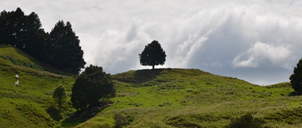
Large trees provide shelter for the stock from both the sun and rain

In the first week of February Anoek, a Bachelor of Science intern from the Netherlands, conducted five-minute bird counts in different habitat types around the farm with the aim of comparing how the different vegetation affects the species of birds present. Her data is still being processed but she did hear many native birds including ngirungiru/miromiro/tomtit, riroriro/grey warbler, tūī, kererū and koekoeā/long-tailed cuckoo. Koekoeā spend winter on smaller Pacific islands near the Phillipines but migrate to New Zealand to breed in summer. They are famous for laying their eggs in the nests of other birds like riorio and leaving them to raise the chicks.

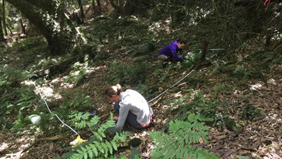
The whole team was involved in setting up the first of our “Tier 1” plots. These are replicates of the nation-wide monitoring protocol the Department of Conservation uses to monitor vegetation on public conservation land. We will be setting up nine permanent plots in different habitat types around the farm and permanently marking them, so Te Uranga B2 Incorporation can compare the native vegetation and coarse woody debris that there is there now, with what is there in the future.

The plots are 20m x 20m and within this we measure and tag large trees (more than 135cm) - both standing and fallen. We also record all the understory species (less than 135cm) down to the tiniest kahikatea seedling. Taking soil samples allows us to analyse the nutrient content and see how the vegetation affects the soil, and vice versa.

Chloé Mathieu (PhD candidate) and Johanna Spaak (research assistant) from Auckland University of Technology take a good look at the seedlings growing under large tōtara trees in our first Tier 1 plot.

We managed to get a lot done in our two weeks on Upoko, but there are many more boxes to tick! We will hopefully be back on the farm sometime around April to continue finding out about this unique piece of land.

Stacey Bryan, Research Assistant | Farming & Nature Conservation, University of Canterbury

Christchurch